
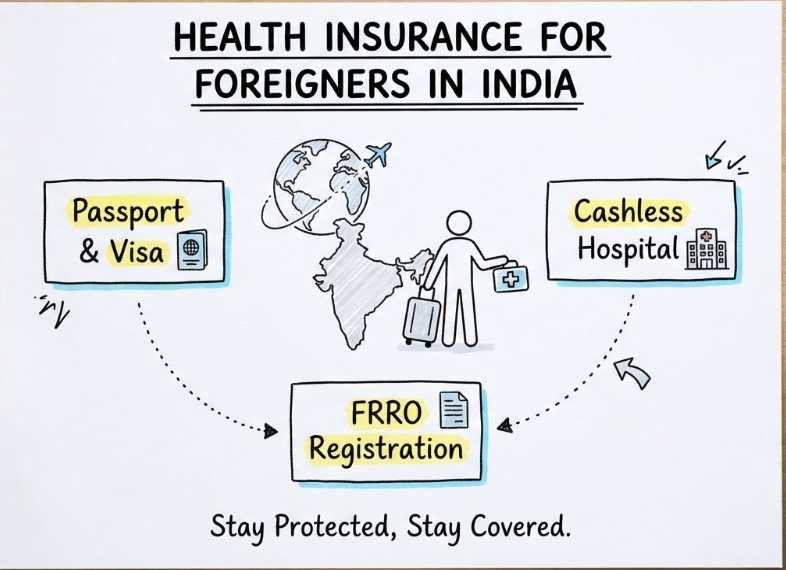
India is fast becoming a top destination for expats, foreign workers, students, and NRIs due to its growing economy, cultural diversity, and career opportunities. But along with relocating comes a critical question: what happens if you fall sick or face a medical emergency? This is where health insurance for foreigners in India becomes essential.
Unlike Indian citizens, foreign nationals aren’t eligible for government-subsidized healthcare schemes, and out-of-pocket treatment at private hospitals can be expensive. This guide covers everything you need to know before buying health insurance in India—including eligibility, coverage types, FEMA rules, and common mistakes to avoid.
Table of Contents
Why Foreigners Need Health Insurance in India
India’s private healthcare system offers high-quality treatment, but it operates entirely at private-market rates. Public subsidies and government welfare schemes are reserved strictly for Indian citizens. Foreigners cannot access these services and must rely exclusively on private healthcare.
Without adequate insurance, a single hospitalization for a serious illness or accident can create a significant financial burden—especially for students, expat employees, or long-term visa holders without employer-provided coverage.
Who Can Buy Health Insurance in India as a Foreigner?
Yes, foreign nationals can legally buy health insurance in India for themselves and their families. This includes:
- Expats working in India on a valid employment visa
- Foreign students studying at Indian educational institutions
- Non-Resident Indians (NRIs) returning to India
- Dependents and family members of foreign employees or students
To establish eligibility, insurers typically require a valid passport, a valid visa (work, student, or residency), and proof of Indian address (such as a rental agreement or FRRO registration certificate).
7 Key Things to Know About Health Insurance for Foreigners in India
1. Foreigners Are Not Covered Under Government Health Schemes
India’s public health initiative, Ayushman Bharat, is designed exclusively for Indian citizens registered in the national database. Foreign nationals are entirely ineligible, making private health insurance your only safety net.
2. Premium Payments and Repatriation Rules (FEMA Guidelines)
Under the Foreign Exchange Management Act (FEMA), foreign nationals are permitted to pay health insurance premiums in foreign currency. If premiums are paid this way, claim payouts can legally be repatriated back to your home country. If paid in Indian currency (INR), repatriation of claim amounts is generally restricted.
3. Local vs. International Health Insurance Plans
Foreigners in India typically choose between two types of coverage:
- Local Indian health insurance plans – Offered by domestic insurers, these focus on hospitalization and cashless treatment within India at a lower premium.
- International/global health insurance plans – Designed for expats who travel frequently or want medical coverage beyond India, though they come at a higher cost.
4. Cashless Hospitalization at Network Hospitals
Leading Indian insurers offer cashless treatment facilities at their network hospitals. This means you don’t need to pay upfront and file for reimbursement later; the insurer settles the medical bill directly with the hospital.
5. Age Restrictions and Medical Screenings
Applicants crossing a certain age threshold (commonly 45 to 50 years, depending on the insurer) are typically required to undergo a medical screening before policy underwriting is approved. Younger applicants can often skip this step.
6. Emergency Evacuation Isn’t Always Included
Many standard domestic Indian health policies do not automatically cover international emergency medical evacuation. If you reside outside major metropolitan hubs or require cross-border medical transit, you may need an international plan or a specialized rider.
7. Short-Term Travel Insurance Isn’t a Substitute
Many expats mistakenly rely on short-term travel insurance. Travel policies are built strictly for temporary trips, routinely exclude routine healthcare and pre-existing conditions, and are legally unsuitable for anyone living and working in India long-term.
Documents Typically Required
When applying for a policy, keep the following documentation ready:
- Valid passport
- Valid visa (work, student, or long-term residency)
- Proof of Indian address (rental agreement, employer verification letter, or FRRO registration)
- Passport-size photograph
- Age proof and medical screening reports (if applicable)
How to Choose the Right Plan
When comparing health insurance options in India, evaluate:
- Network hospital coverage in your specific city of residence
- Sum insured relative to private hospital costs in that city
- Whether Outpatient Department (OPD), maternity, or dental coverage is included
- Claim settlement process and cashless network availability
- Premium payment currency and repatriation terms (especially for NRIs)
Final Thoughts
Relocating to India comes with plenty to plan for, and healthcare shouldn’t be an afterthought. Because foreign nationals cannot access public health subsidies, obtaining a robust private health insurance policy is essential for financial protection against unexpected medical costs. Evaluating your visa terms, coverage limits, and documentation requirements in advance will help you make a well-informed decision.
Disclaimer: This information is for educational purposes only and does not constitute formal financial or insurance advice. Please consult a licensed insurance provider directly to confirm eligibility and policy wording applicable to your unique situation.